
Counterfactual Badminton Motion Guidance
IEEE ICRA Workshop on Wearable Robotics · 2024 · Lead author
What could a different version of this movement look like?
Copying an expert’s motion does not directly show how a player’s own movement might change. This workshop study explores nearby alternatives that can be compared with the original stroke.
System
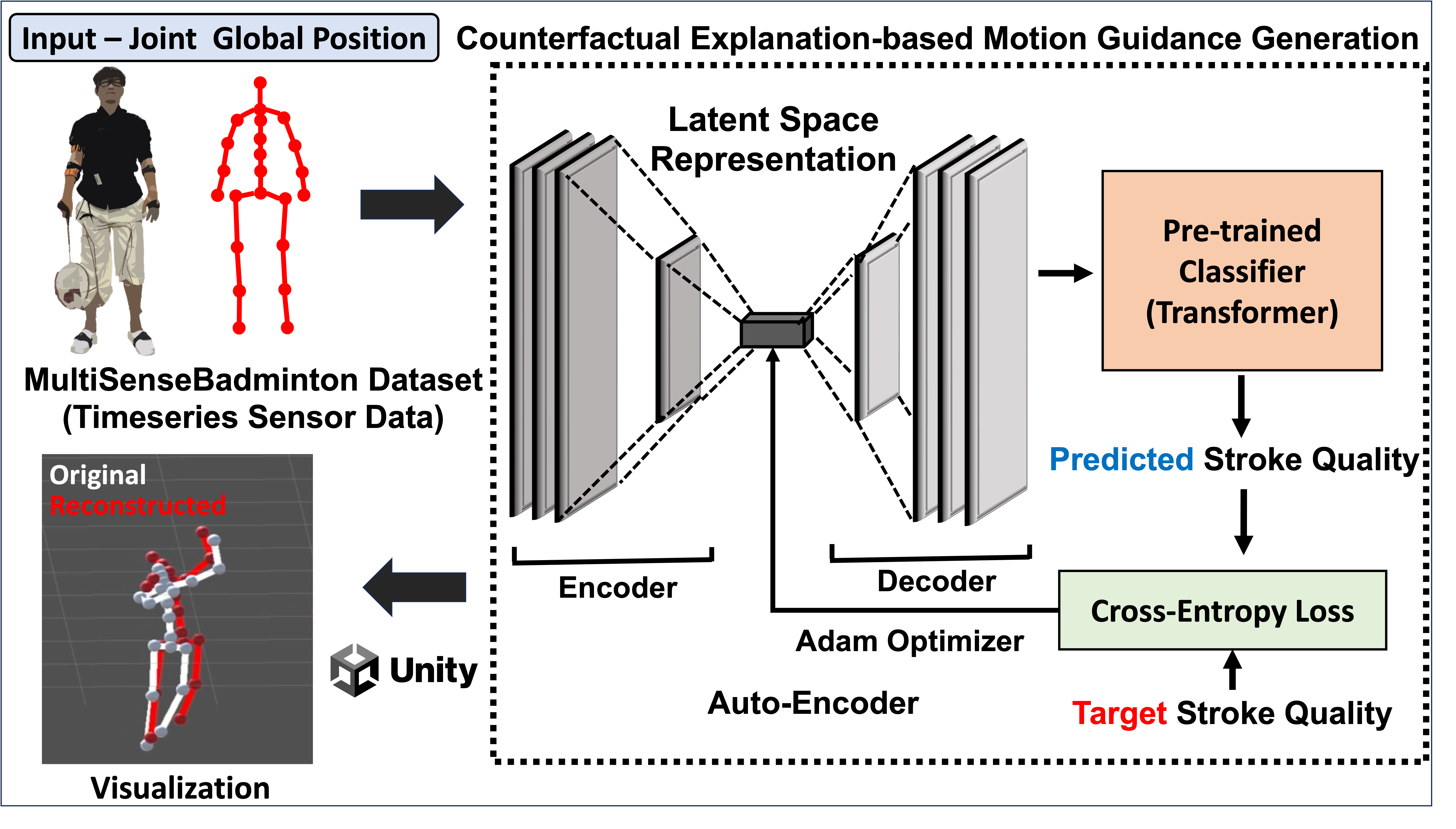
MultiSenseBadminton joint-position sequences feed a stroke-quality classifier. An autoencoder-based search generates counterfactual motions in latent space. A Unity visualization overlays generated and original movements.
Evidence and limits
The 2024 paper compares 100 examples per stroke type with three nearest-neighbor baselines. It evaluates model-based proximity and motion distances. These offline results do not establish that the suggested motions improve a person’s performance or learning; user evaluation is future work.
Resources
Paper title: Counterfactual Explanation-Based Badminton Motion Guidance Generation Using Wearable Sensors.